What Is Color Season Analysis and Why Is Everyone Getting One?
Color season analysis sorts people into seasonal palettes (Spring, Summer, Autumn, Winter) based on skin undertone, contrast level, and natural coloring. Professional color analysis sessions in Korea cost around $300. That price tag kept most people from ever finding out their season.
Then AI changed the equation. An Instagram reel by @iam_grincy (649K followers) captioned “now you don’t have to go to Korea to get your personal color analysis” showed people how to upload a selfie and get their full color season breakdown for free. The post went viral in late April 2025 and kicked off a wave of creators posting their AI-generated results across Instagram, TikTok, and X.
The appeal goes beyond vanity. Knowing what colors look good on you affects wardrobe decisions, makeup purchases, hair color choices, and even jewelry shopping. A color season analysis turns guesswork into a reference chart you can pull up in a fitting room.
How Does an AI Color Season Analysis Work?
The AI evaluates your photo for three attributes:
- Undertone: whether your skin leans warm, cool, or neutral
- Contrast level: the difference between your skin, hair, and eye colors
- Season classification: which of the 12 sub-seasons (Warm Autumn, Cool Winter, Light Spring, etc.) matches your natural coloring
From those three inputs, it generates a full report. The Personal Color Analysis template on MuleRun Chat produces a visual report page that includes your season, best and worst colors, and styling recommendations all in one shareable link.
Traditional colour analysis free tools online give you a quiz with 5-10 multiple choice questions (“are your veins blue or green?”). The results are a generic season label with a stock palette. AI analysis skips the quiz entirely and reads your actual coloring from the photo.
What Does the Color Analysis Report Include?
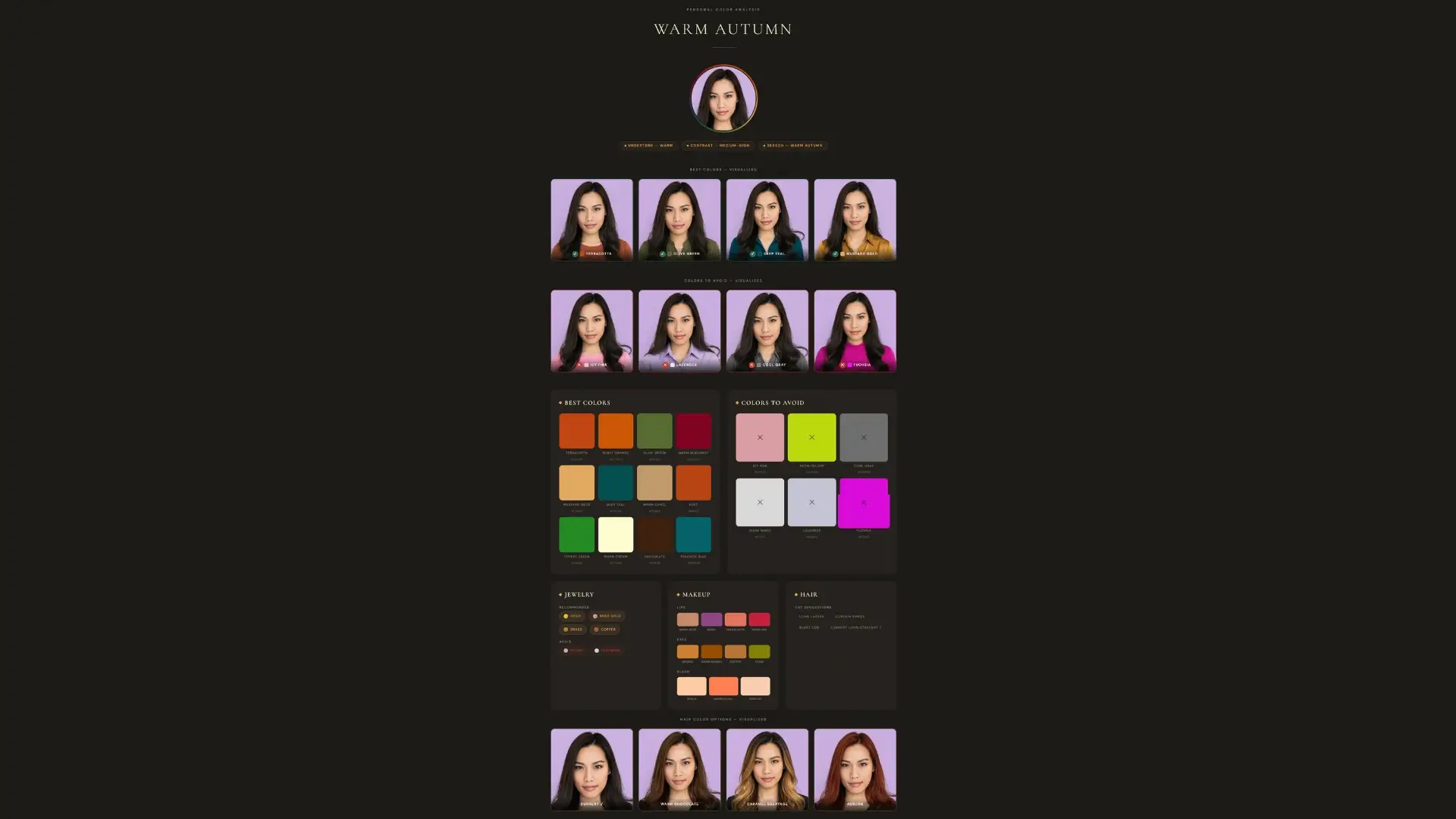
The report from MuleRun Chat covers six sections:
- Your season and sub-season: displayed with your portrait photo and badges showing undertone, contrast level, and season name
- Best colors visualized: four cards showing you wearing your top recommended colors (generated from your photo)
- Colors to avoid visualized: four cards showing colors that clash with your natural coloring
- Color palette with hex codes: 12 best colors and 6 colors to avoid, each with exact hex values so you can match them when shopping online
- Jewelry and metal recommendations: which metals complement your undertone (gold, rose gold, brass, copper) and which to skip
- Makeup and hair suggestions: lip colors, eye shadow shades, blush tones, haircut styles, and hair color options specific to your season
The hex codes are what make this report practical. Screenshot the palette, save it to your phone, and pull it up when browsing clothing sites or standing in the makeup aisle. A color for your skin tone chart that lives in your camera roll is more useful than a generic “you are an Autumn” label.
How Do You Get a Free Colour Analysis from AI?
The process takes about 30 seconds:
- Open the Personal Color Analysis template in MuleRun Chat
- Upload a clear, front-facing photo with natural lighting (avoid heavy filters or flash)
- The AI generates a full-page visual report with your season, color palettes, and styling recommendations
- Share the report link or screenshot your results for social media
For the most accurate results, use a photo where your natural hair color is visible, you are wearing minimal makeup, and the lighting is neutral (daylight near a window works best). The AI reads your actual skin, hair, and eye colors, so anything that alters those will shift the results.
You can also customize the analysis. Add instructions to the prompt like “include professional workwear color recommendations” or “focus on men’s styling” and the report adjusts accordingly.
What Makes This Different from Color Analysis Quizzes?
Online color analysis quizzes ask you to self-assess: “is your skin warm or cool?” Most people cannot answer that accurately, which makes the quiz results unreliable.
AI color analysis reads your photo directly. It does not ask you to guess your undertone. It detects it. That removes the biggest source of error in traditional colour analysis free tools.
The other differences:
- Visual proof: the report shows you wearing recommended colors, so you can see the difference instead of imagining it
- Specific hex codes: not just “earth tones” but #C1440E Terracotta and #556B2F Olive Green, precise enough to match online
- Complete styling: jewelry metals, makeup shades, hair colors, and cut suggestions all in one report
- Shareable format: the report generates as a web page you can send to friends or your stylist
Get Your Personal Color Analysis
Open the Personal Color Analysis template in MuleRun Chat, upload your selfie, and find out what colors look good on you in 30 seconds.
See more use cases.
Frequently Asked Questions
Is the AI color analysis accurate?
The analysis is based on visible skin undertone, contrast, and natural coloring from your photo. Results are most accurate with natural lighting, minimal makeup, and visible natural hair color.
Is the Personal Color Analysis free?
Yes. Open the template in MuleRun Chat, upload a selfie, and get your full report at no cost.
What is the difference between the 4 seasons and 12 sub-seasons?
The four base seasons (Spring, Summer, Autumn, Winter) each split into three sub-seasons based on whether your coloring leans warm, cool, or neutral. For example, Autumn splits into Warm Autumn, Deep Autumn, and Soft Autumn.
Can I use this for men’s color analysis?
Yes. Add “men’s styling” to the prompt and the report adjusts recommendations for menswear, grooming, and hair.
What should I wear in the photo for best results?
A white or neutral top works best. Avoid heavy makeup, colored contacts, or strong lighting filters. Natural daylight near a window gives the most accurate read.