Pythagoras Math Problems With Answers (Free, 2026)
A tutor needed a way for students to practice Pythagorean theorem problems without printing worksheets or hunting for answer keys. They described an interactive practice site in MuleRun Chat and got back Pythagoras Lab, a browser-based tool that generates unlimited problems with instant feedback.
MuleRun Chat is an AI chat that builds web pages, games, and tools from plain language. You describe what you want, Chat writes the code, and you get a shareable link.
What Types of Pythagoras Math Problems Can You Practice?
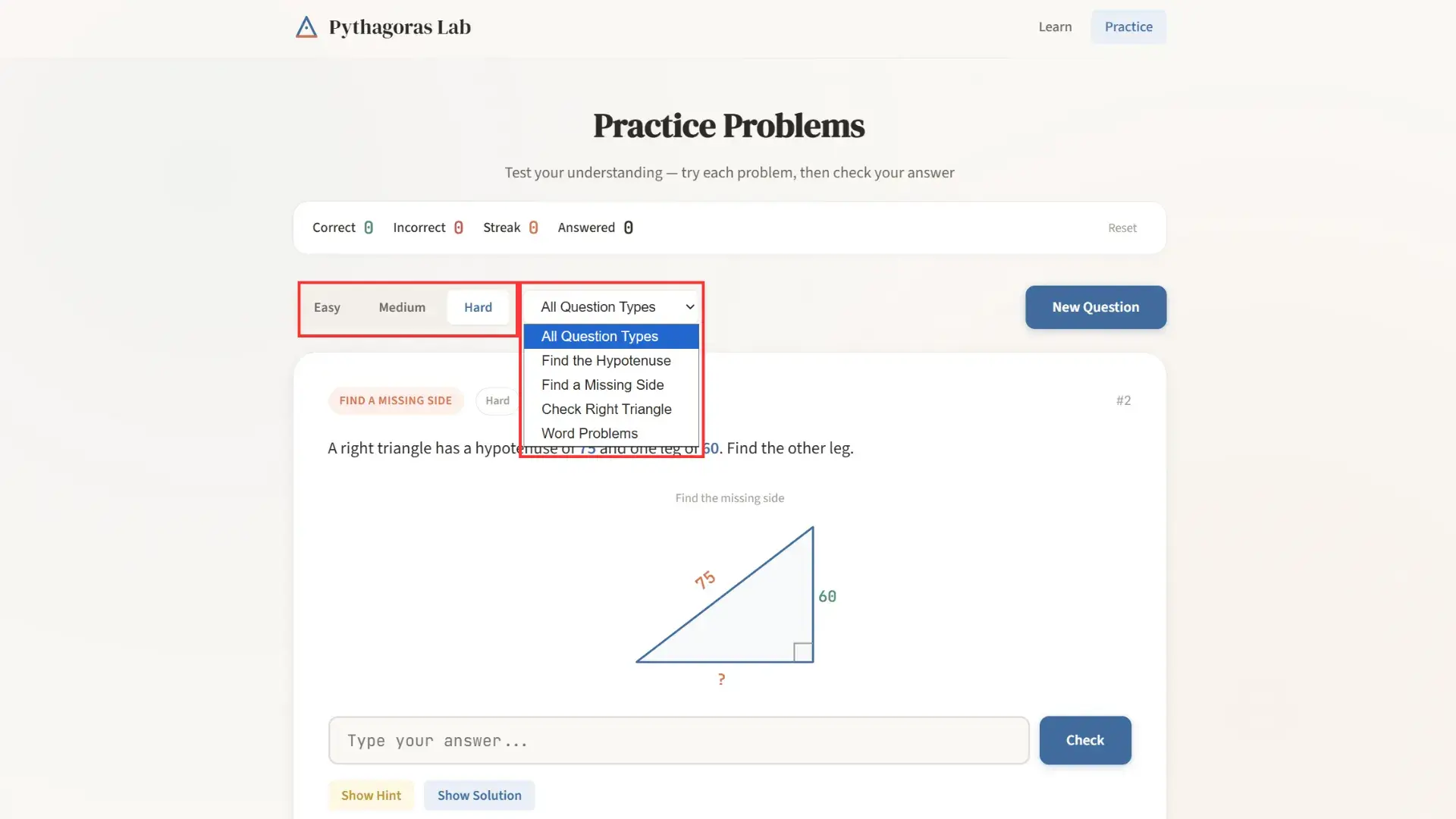
The site covers four problem types, each with easy, medium, and hard difficulty levels:
- Find the hypotenuse: given two legs of a right triangle, calculate the longest side using c = √(a² + b²)
- Find a missing leg: given the hypotenuse and one leg, solve for the other using a = √(c² − b²)
- Check a right triangle: given three side lengths, determine whether they satisfy a² + b² = c²
- Word problems: apply the theorem to real situations like ladders against walls, diagonal paths across fields, and distances between landmarks
Easy problems use familiar Pythagorean triples (3-4-5, 5-12-13, 8-15-17). Medium problems increase the numbers while keeping whole-number answers. Hard problems involve larger values and multi-step word problems that require identifying which sides are legs and which is the hypotenuse before calculating.
A Learn section above the practice area explains the theorem, identifies the hypotenuse, and walks through both solving directions with worked examples. Students who need a refresher read the four concept cards, then scroll down and start solving.
How Do You Solve Hard Pythagorean Theorem Problems?
The jump from easy to hard problems trips up most students. Easy questions hand you two numbers and a formula. Hard questions bury the numbers inside a story and expect you to figure out which value is which before you calculate anything.
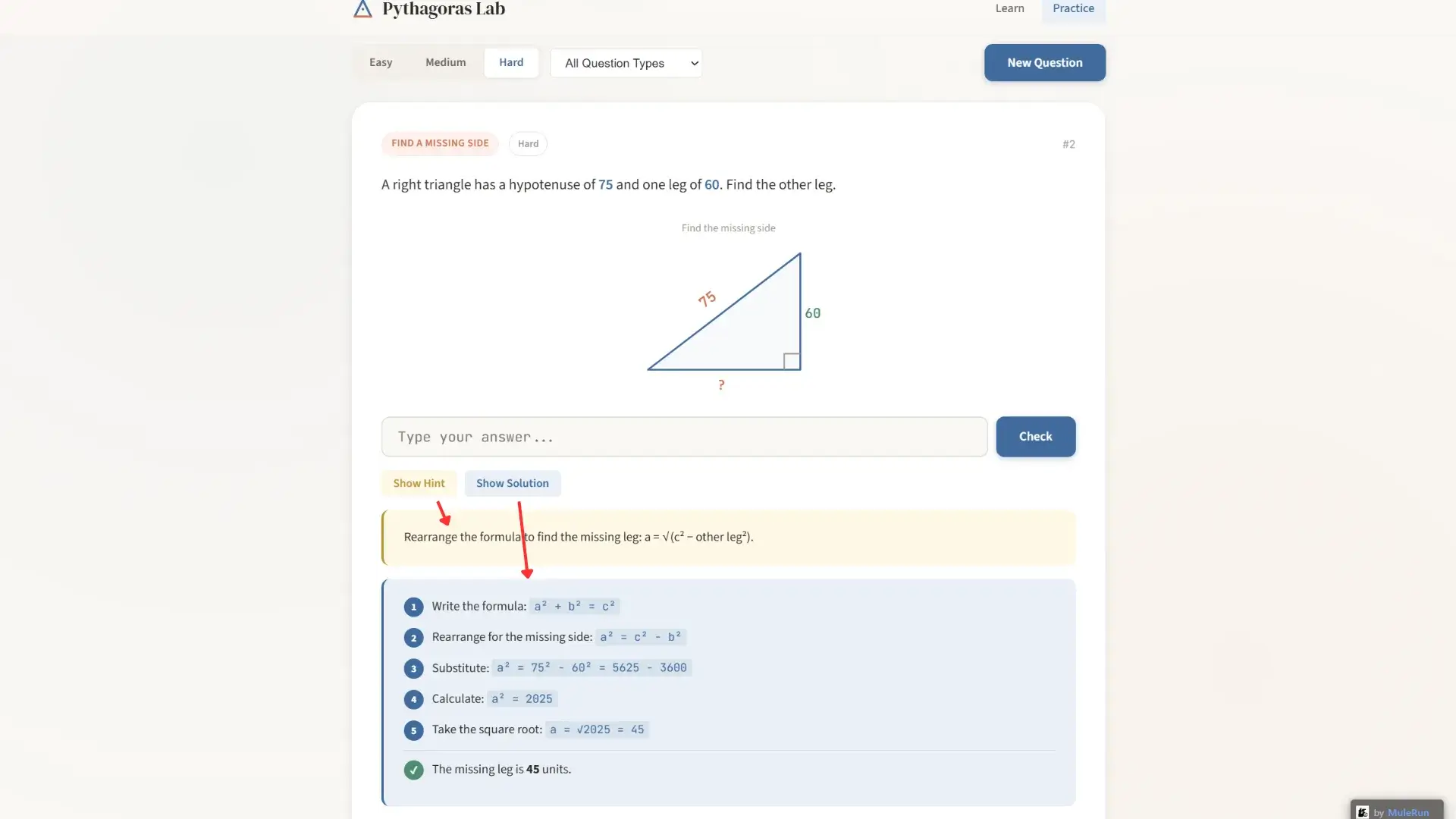
Pythagoras Lab walks through each solution in numbered steps:
- Write the formula: a² + b² = c²
- Identify the values: which measurement is the hypotenuse and which are legs
- Substitute and calculate: plug in the known values and square them
- Solve for the unknown: take the square root of the result
For example, a hard word problem might describe a ladder leaning against a wall: the base sits 30 metres away and the ladder is 78 metres long. The ladder is the hypotenuse (it stretches from ground to wall), so you solve a = √(78² − 30²) = √(6084 − 900) = √5184 = 72 metres.
Each problem also has a hint button that shows the relevant formula without giving the answer. This lets students attempt the calculation themselves before viewing the full solution. The score tracker at the top records correct answers, wrong answers, and current streak, so students can measure their progress across a session.
What Makes Interactive Practice Better Than Worksheets?
Most search results for Pythagorean theorem practice lead to PDF worksheets or static article listings with 10-15 problems. Those work once. Pythagoras Lab generates fresh problems every time you click New Question, across all four types and three difficulty levels.
| Feature | PDF Worksheets | Pythagoras Lab |
|---|---|---|
| Problem variety | Fixed set (10-15) | Unlimited (randomized) |
| Answer feedback | End of document | Instant per question |
| Hints | None | Formula guidance on demand |
| Step-by-step solutions | Sometimes included | Every problem |
| Progress tracking | Manual | Automatic (score + streak) |
The instant feedback loop matters for learning. Research from the National Council of Teachers of Mathematics shows that immediate corrective feedback during mathematics practice increases retention compared to delayed grading. Students see what they got wrong and why before moving to the next problem, instead of repeating the same mistake across an entire worksheet.
The combination of hints and solutions also supports independent learning. A student practicing alone at home can get unstuck without waiting for a parent or teacher to explain the next step.
How Was This Practice Site Built With No Code?
The tutor described what they wanted in a single conversation: a site that teaches the Pythagorean theorem, then lets students practice with problems at three difficulty levels, with hints and step-by-step solutions for every question. MuleRun Chat generated the entire site, including the Learn section with concept cards, the practice problem generator, SVG triangle diagrams, the scoring system, and the warm minimal design.
Revisions happened in the same chat. The tutor asked for word problems about real-life scenarios, a streak counter for motivation, and a Check Right Triangle question type. Each update went live at the same URL.
Any teacher, parent, or student can do the same for any math topic. Use the Educational Interactive Practice Site template to start with this structure, then tell Chat what subject you need: quadratic equations, fraction operations, trigonometry, or anything else. Chat builds a fresh practice site with the same interactive format.
Ready to Build Your Own Practice Site?
Sign up for MuleRun Chat, describe the math topic your students need, and share the practice link with your class.