
How Does Math Champions Work as an Online Card Game?
A parent typed a description of a math card game into MuleRun Chat and got back Math Champions, a playable browser game where kids race an AI robot named Robo to 10 stars. No app installs, no accounts, no physical cards to lose under the couch.
MuleRun Chat is an AI chat that builds web pages, games, tools, and documents from plain language descriptions. You describe what you want, and Chat returns a shareable URL with the finished product.
Each round works like this: a target number between 3 and 27 appears in an orange bubble at the center of the screen. Players hold five cards each (values 1 through 10 across five color-coded suits). You pick two cards and one operation to calculate a result as close to the target as possible.
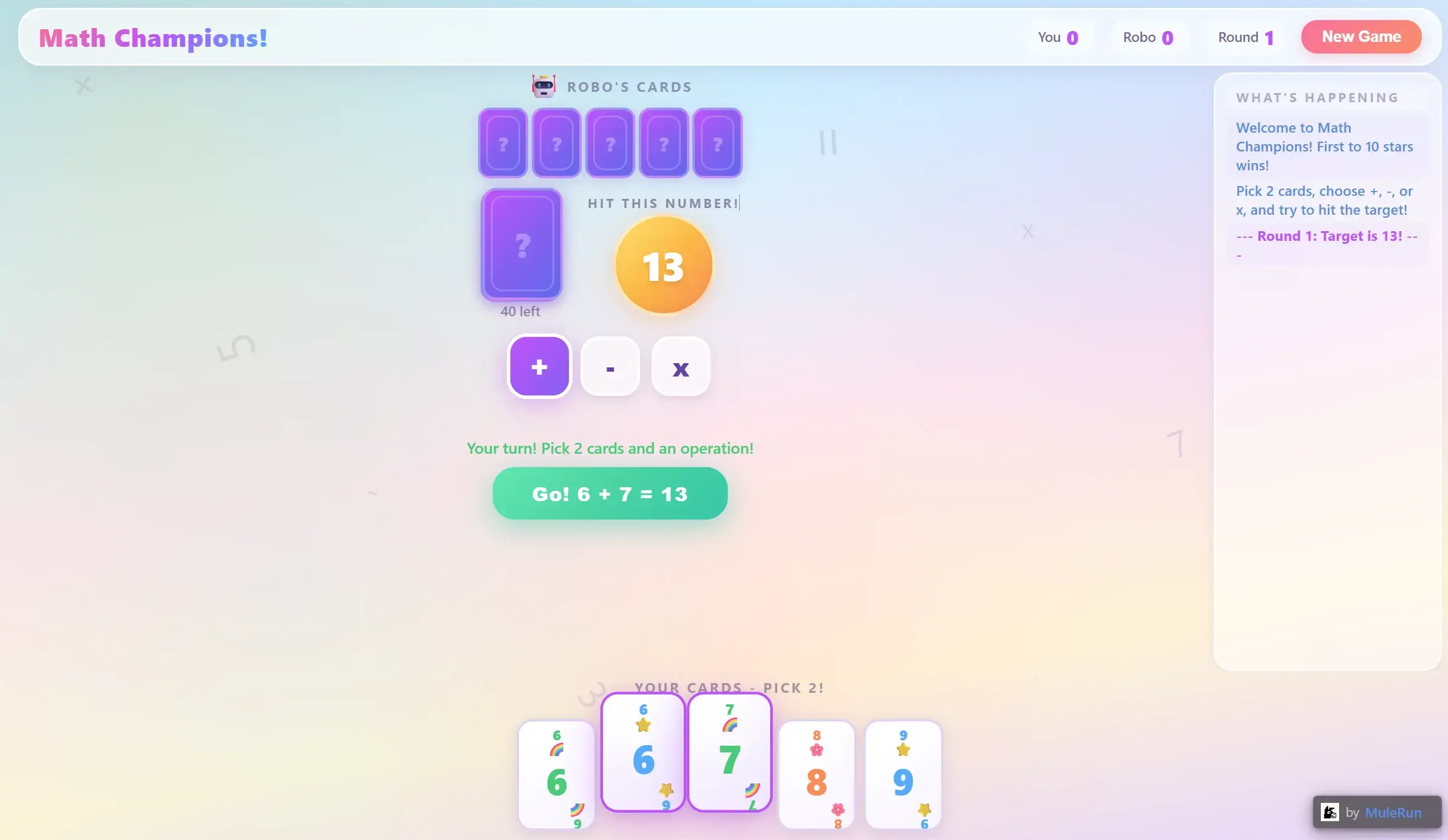
- Select two cards: tap any two cards in your hand to highlight them
- Choose an operation: pick addition, subtraction, or multiplication from the three buttons
- Hit Go: a preview shows your calculation before you commit
- Compare results: Robo plays its own two cards and the closer result earns a star
The game log on the right tracks every move with exact calculations and how far each player landed from the target. Robo plays smart. It checks every possible card and operation combination in its hand and picks the one closest to the target, so beating it requires real number sense.
What Math Skills Do Kids Practice Playing Math Card Games?
Every round reinforces three arithmetic operations without feeling like a worksheet. The target number forces kids to think backwards: given a goal of 18, is 4 x 5 = 20 (off by 2) better than 9 + 8 = 17 (off by 1)? That kind of mental comparison builds number fluency.
Specific skills the game exercises:
- Addition fluency: combining two single-digit numbers under time pressure from Robo
- Subtraction with strategy: deciding when subtracting gives a closer result than adding
- Multiplication tables: spotting that 3 x 7 = 21 hits a target of 22 better than 9 + 9 = 18
- Estimation and comparison: calculating distance from the target to decide which operation wins
- Strategic thinking: choosing which two of five cards to play while saving useful cards for future rounds
The competitive format matters. Research from the Stanford DREME Network shows that game-based math practice increases engagement and retention compared to traditional drills. Playing against Robo gives kids a reason to care about getting the answer right, because they want to win.
How Was This Math Card Game Built With No Code?
The entire game came from a text conversation. The parent described what they wanted: a card game where kids pick two cards and a math operation to hit a target number, with an AI opponent and star-based scoring. Chat generated the complete game, including card rendering across five colored suits, the Robo AI logic, animated card dealing, a game log, and three different game-over screens for wins, losses, and ties.
After the first version loaded, the parent kept refining it through the same chat. They asked for encouraging messages when kids win a round, a New Game button, and better visual feedback when cards are selected. Each revision updated the live page instantly.
You can start from the same base using the Math Champions template. Open it, describe what you want to change (harder target numbers, division as a fourth operation, a classroom leaderboard), and Chat generates an updated version.
How Does It Compare to Other Card Games for Kids?
Most lists of card games for kids recommend Go Fish, War, and Crazy Eights. Those are fun, but they exercise memory and pattern matching rather than arithmetic. Math Champions sits in a smaller category: easy card games that also teach math.
| Game | Math Involved | Players | Setup Time |
|---|---|---|---|
| Math Champions | Addition, subtraction, multiplication | 1 (vs AI) | 0 seconds (browser) |
| Go Fish | Counting only | 2-6 | 2 minutes (shuffle + deal) |
| War | Number comparison | 2 | 2 minutes |
| Crazy Eights | None | 2-7 | 2 minutes |
| Addition War | Addition | 2 | 3 minutes (custom setup) |
| Make 10 | Addition to 10 | 1-4 | 2 minutes |
The online format removes a common friction point with math card games for kids. Physical versions like Addition War require a parent or teacher to verify answers, set up the deck, and referee disputes. The digital version handles all of that automatically.
What Makes MuleRun Chat Different for Building Kids’ Games?
Typical online math card games come from education companies with development teams. MuleRun Chat puts that same output in the hands of anyone who can describe what they want.
- Customization: change the math operations, card values, target range, or theme by editing your prompt
- Speed: a working game appears from the first prompt, and revisions happen in the same conversation
- No cost or technical knowledge: you write sentences describing the game, Chat writes the code
A teacher who wants multiplication-only practice for fourth graders can ask for that. A parent who wants addition-only with numbers up to 5 for a kindergartner can ask for that. The same tool produces both variations because the game rules come from the prompt, not from a fixed product roadmap.
Ready to Create a Math Game for Your Kids?
Sign up for MuleRun Chat, describe the math game your kids need, and share the link with them.