Why Do Mexican Parents Struggle with Fraction Homework?
Mexico’s adult population averages 9.7 years of formal schooling, meaning most parents finished partway through secondary school. That gap matters the moment a fourth grader brings home the SEP curriculum’s fraction unit. The Secretaría de Educación Pública introduces proper fractions, equivalences, and simple operations in the fourth-grade mathematics block, and many parents find themselves staring at a worksheet they cannot confidently explain.
One mother in Monterrey faced exactly this situation. Her daughter was starting the SEP fraction chapter, and the standard textbook approach felt flat: static diagrams, repetitive exercises, and no feedback loop. Hiring a private tutor was out of budget. Searching for free online fraction tools returned English-only apps or ad-heavy websites that lost her daughter’s attention in seconds.
She decided to build her own solution. With no programming background and no design experience, she opened MuleRun Chat, described what she wanted in plain Spanish, and walked away with a fully functional pizza-slicing fraction game her daughter could play on a tablet at home.
How Mathematics in Games Help Children Learn Fractions
Research in mathematics education consistently shows that children absorb abstract concepts faster when they can manipulate visual objects. Fractions are notoriously difficult because they break a child’s early mental model of numbers as whole, countable things. A pizza solves that problem instantly: every child already understands that a pizza is one whole, and cutting it creates parts.
Mathematics in games works because it replaces passive memorization with active decision-making. Instead of reading “1/4 means one part out of four,” a student drags a knife across a pizza, counts the slices, and sees the fraction label update in real time. The feedback is immediate, the stakes feel real (nobody wants uneven pizza), and the repetition is voluntary because the child wants to beat the level.
This approach aligns with how the SEP curriculum sequences fraction learning across fourth grade:
- Identifying equal parts: students recognize that fractions require equal divisions
- Reading and writing fractions: students connect the symbolic notation (numerator/denominator) to a visual
- Comparing fractions: students determine which fraction is larger using the same whole
- Adding fractions with the same denominator: students combine parts and express the result
A well-designed classroom game mirrors this exact progression, turning each concept into a distinct challenge level. That is precisely what this mother built.
What Does This Math Game for Grade 4 Look Like?
The game lives at a single link her daughter can tap on any device: play the pizza fraction game. It opens with a colorful level selector that presents four stages, each mapped to one SEP learning objective. No login, no ads, no downloads.
Math games for grade 4 often cram dozens of unrelated skills into a single app. This game does the opposite: it teaches one concept per level, in the order the SEP curriculum introduces them.
Level 1: Cut the Pizza into Equal Parts
The screen shows a whole pepperoni pizza. A prompt asks the student to divide it into a specific number of equal slices, such as 4 or 6. The child taps or drags to place cuts. The game checks whether the slices are truly equal and displays the resulting fraction for each piece. If the cuts are uneven, the game nudges the student to try again.
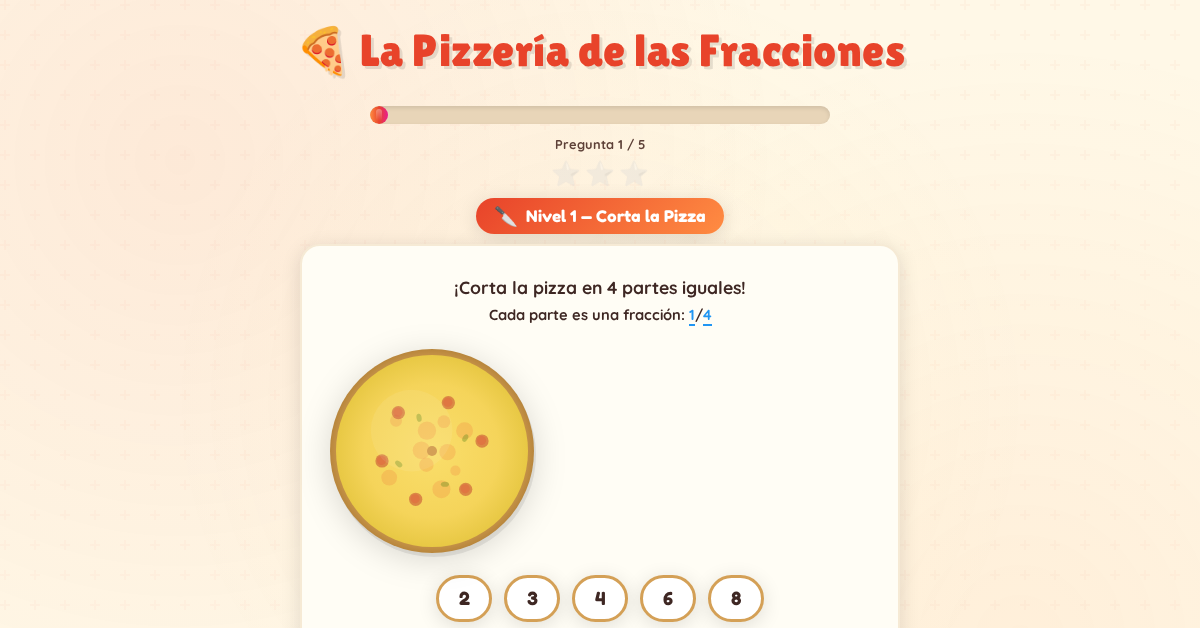
This level builds the foundational idea that fractions only make sense when parts are equal, which is the single most common misconception among fourth graders.
Level 2: Match Written Fractions to Visuals
The student sees a pizza already sliced and must select the correct written fraction from multiple choices. For example, a pizza cut into 3 equal pieces with 2 highlighted asks the student to pick 2/3 from a set of options. Each round randomizes the denominator and the number of highlighted slices.
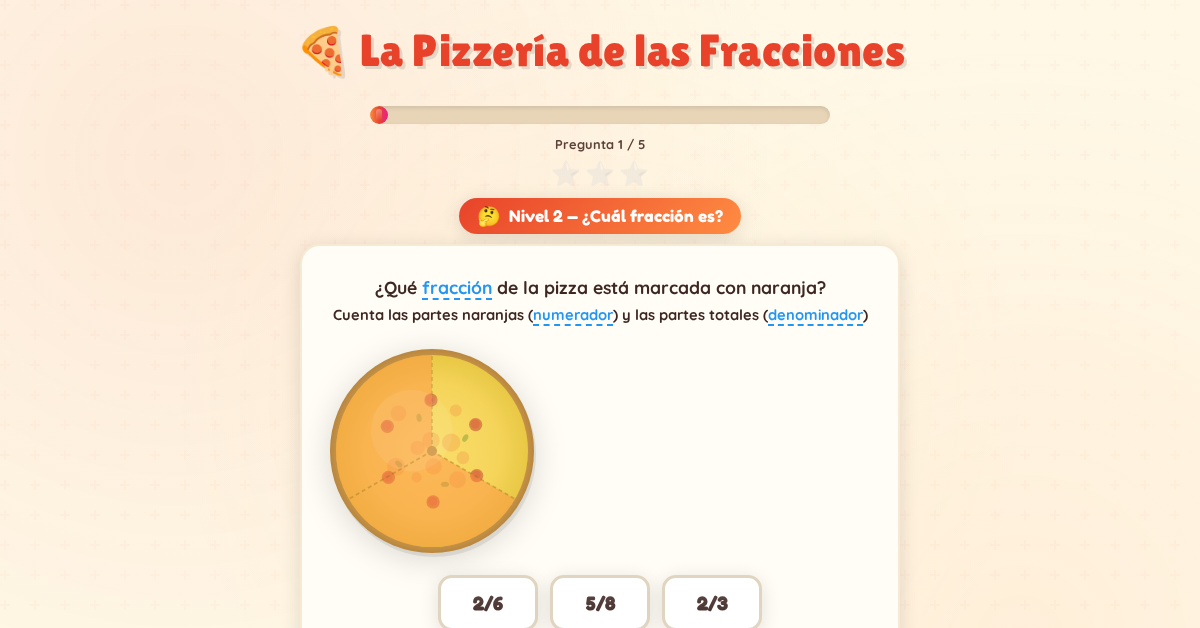
This level trains the connection between the visual model and symbolic notation, which is the bridge many students struggle to cross.
Level 3: Compare Fraction Sizes
Two pizzas appear side by side, each with a different fraction shaded. The student decides which fraction is larger. The visual makes the comparison intuitive: more shaded pizza means a bigger fraction. After answering, the game reveals the numeric reasoning so the child learns the rule, not just the visual shortcut.
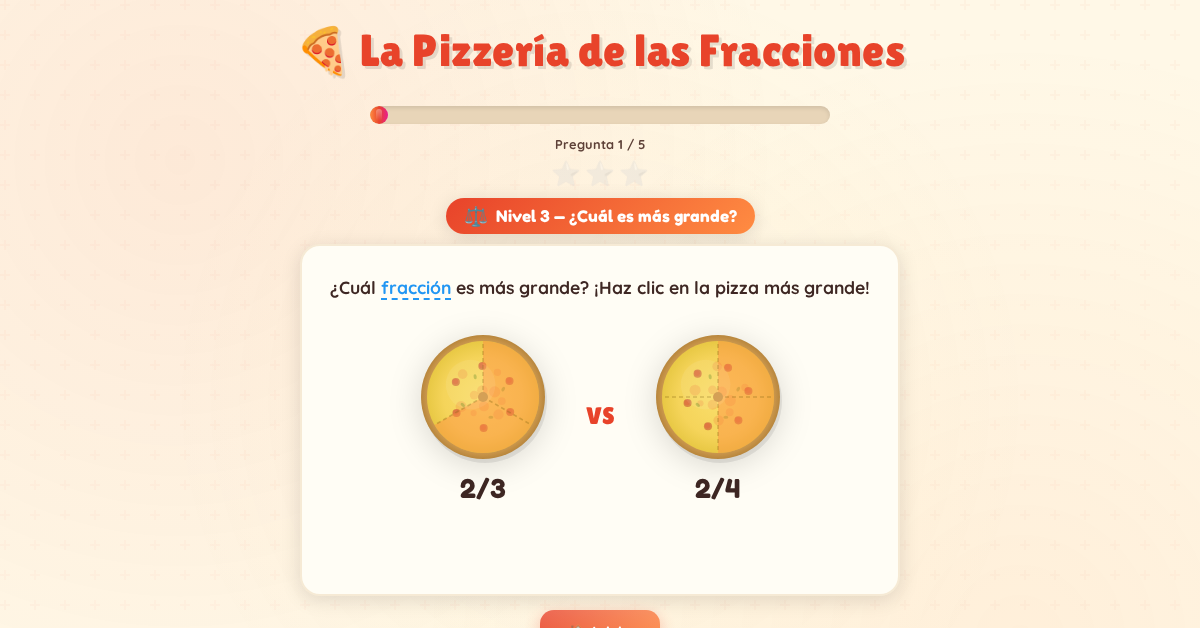
Comparison is where many worksheet-based approaches fail because students memorize “bigger denominator means smaller fraction” without understanding why. Seeing two pizzas side by side makes the logic visceral.
Level 4: Add Same-Denominator Fractions
The student sees two fraction expressions with the same denominator and a pizza visual that combines the shaded portions. The task is to input the sum. For instance, 1/6 + 2/6 shows one slice highlighted, then two more slices highlighted, and the student types 3/6. The game accepts equivalent simplified fractions as correct.
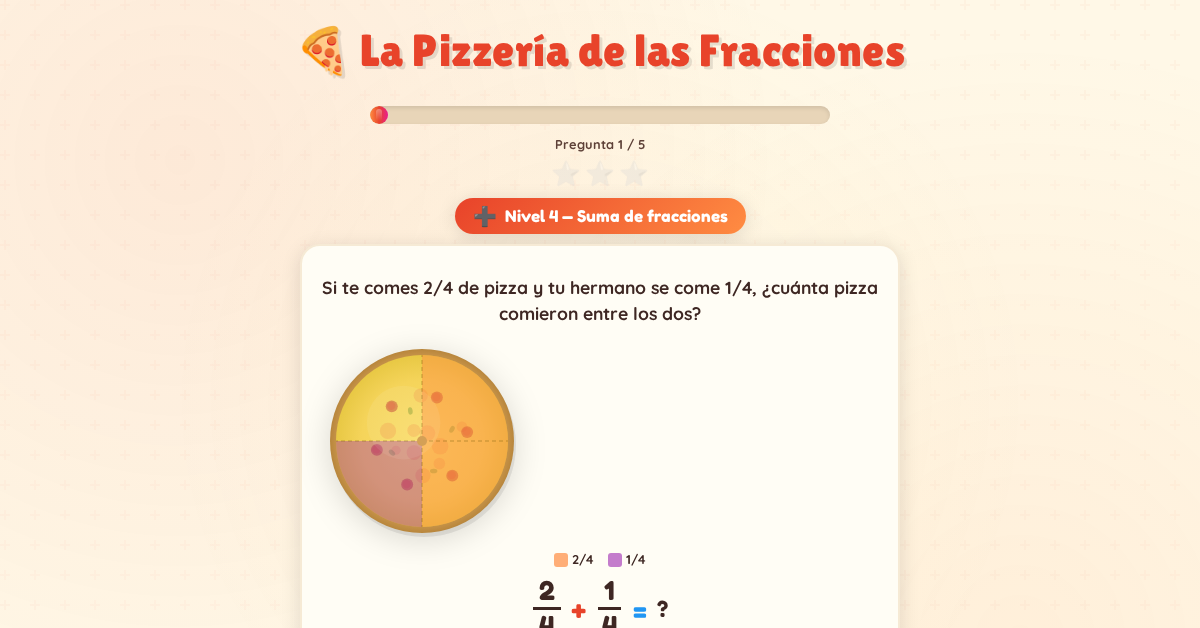
Addition of fractions with common denominators is the final skill in the SEP fourth-grade sequence. Reaching this level feels like an achievement, and the student arrives with three levels of visual reasoning already in place.
How She Built a Classroom Game Without Writing Code
The mother had no GitHub account, no JavaScript knowledge, and no design tools installed. She opened MuleRun Chat and typed a message in Spanish describing what she wanted: a pizza game with four levels that teaches fractions the way her daughter’s SEP textbook introduces them.
MuleRun is a no-code AI agent that turns natural-language descriptions into working web applications. The conversation looked roughly like this:
- She described the game concept: “I want a game where my daughter cuts a pizza into equal parts, then matches fractions, compares them, and finally adds them”
- She specified the grade level: “Fourth grade, following the SEP math curriculum”
- She requested Spanish language: the entire interface, instructions, and feedback appear in Mexican Spanish with SEP vocabulary
- She reviewed each level: MuleRun generated the game, and she tested each stage on her phone, requesting adjustments to colors, difficulty, and wording
- She published it: with one click the game went live at a shareable link she could send to her daughter’s teacher
The entire process took a single afternoon. No code was written by hand. No classroom game toolkit was purchased. The result is a lightweight web page that loads on any device with a browser, from an old Android phone to a school laptop.
What makes this possible is that MuleRun handles the full stack: interface design, game logic, fraction validation, responsive layout, and hosting. The mother focused entirely on the educational content and her daughter’s needs.
What Makes This Different from a Standard Fraction Chart?
A fraction chart is a static reference: rows of bars divided into halves, thirds, fourths, and so on. It is useful for quick lookup, but it does not teach. The student stares at it, nods, and forgets. There is no interaction, no feedback, and no progression.
This pizza game differs from a fraction chart in several concrete ways:
- Active manipulation over passive reading: the student cuts, matches, compares, and adds instead of simply looking at pre-divided bars
- Immediate feedback: the game tells the student whether an answer is correct and shows the reasoning, while a fraction chart offers no response at all
- Sequenced difficulty: four levels follow the SEP curriculum progression, building from physical intuition to symbolic operations
- Cultural relevance: pizza is a food Mexican fourth graders recognize and care about, making the context sticky rather than abstract
- Accessibility: the game loads free on any browser with no app install, while a printed fraction chart requires physical distribution
None of this means a fraction chart has no value. Teachers still use them as quick visual aids. The difference is that a chart is a reference tool, while this game is a learning tool. One reminds, the other teaches.
For parents who want to complement their child’s homework with interactive practice, a purpose-built game closes the gap that a chart leaves open. And when that game is aligned to the exact curriculum the child follows in school, every minute of play reinforces what the teacher introduced that week.
How You Can Build Your Own Math Game Today
You do not need to be a developer. You do not need to understand fractions better than your fourth grader. You need a clear idea of what your child is learning and the ability to describe it in a sentence.
Here is how to start:
- Open MuleRun Chat: go to mulerun.com/chat
- Describe the concept: tell the agent what subject, what grade level, and what kind of interaction you want
- Specify the language: request Spanish, English, or any other language your child speaks
- Test and refine: play through the result yourself, request changes to difficulty or wording
- Share the link: send it to your child, their teacher, or their entire class group chat
Mathematics in games is not a luxury reserved for schools with coding departments or ed-tech budgets. A single parent with a phone and an idea can now produce a classroom game that rivals anything on the app store, tailored exactly to her child’s curriculum.
This mother in Monterrey did not wait for a better app to appear. She built one in an afternoon. You can do the same.
Have an idea for an educational game? Open MuleRun Chat, describe it, and get started now.