
Give MuleRun Chat instructions as simple as “Build a tower defense game where solving math problems correctly strengthens your towers”, and get this educational, yet exciting, game!
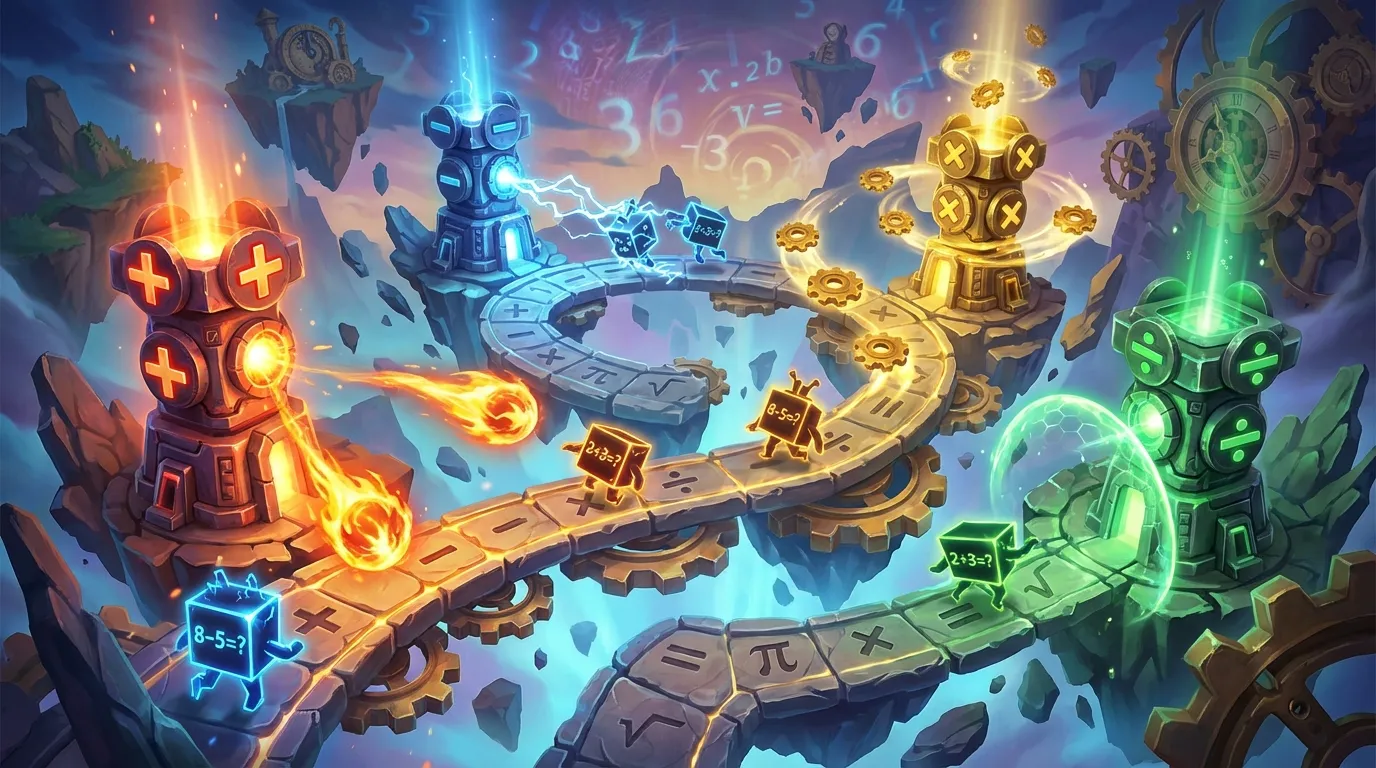
Solve math problems to power up your towers! A brain-training tower defense where quick arithmetic means stronger defenses.
Math Tower Defence has six difficulty tiers from basic addition to mixed operations, a five-level combo system that rewards answer streaks with escalating firepower, wave-based enemy spawning, procedural sound design, per-difficulty leaderboards, and a neon cyberpunk aesthetic. The best part? All MuleRun URLs are playable in any browser without any app installation and account registration.
Fun Math Games for Kids That Actually Work
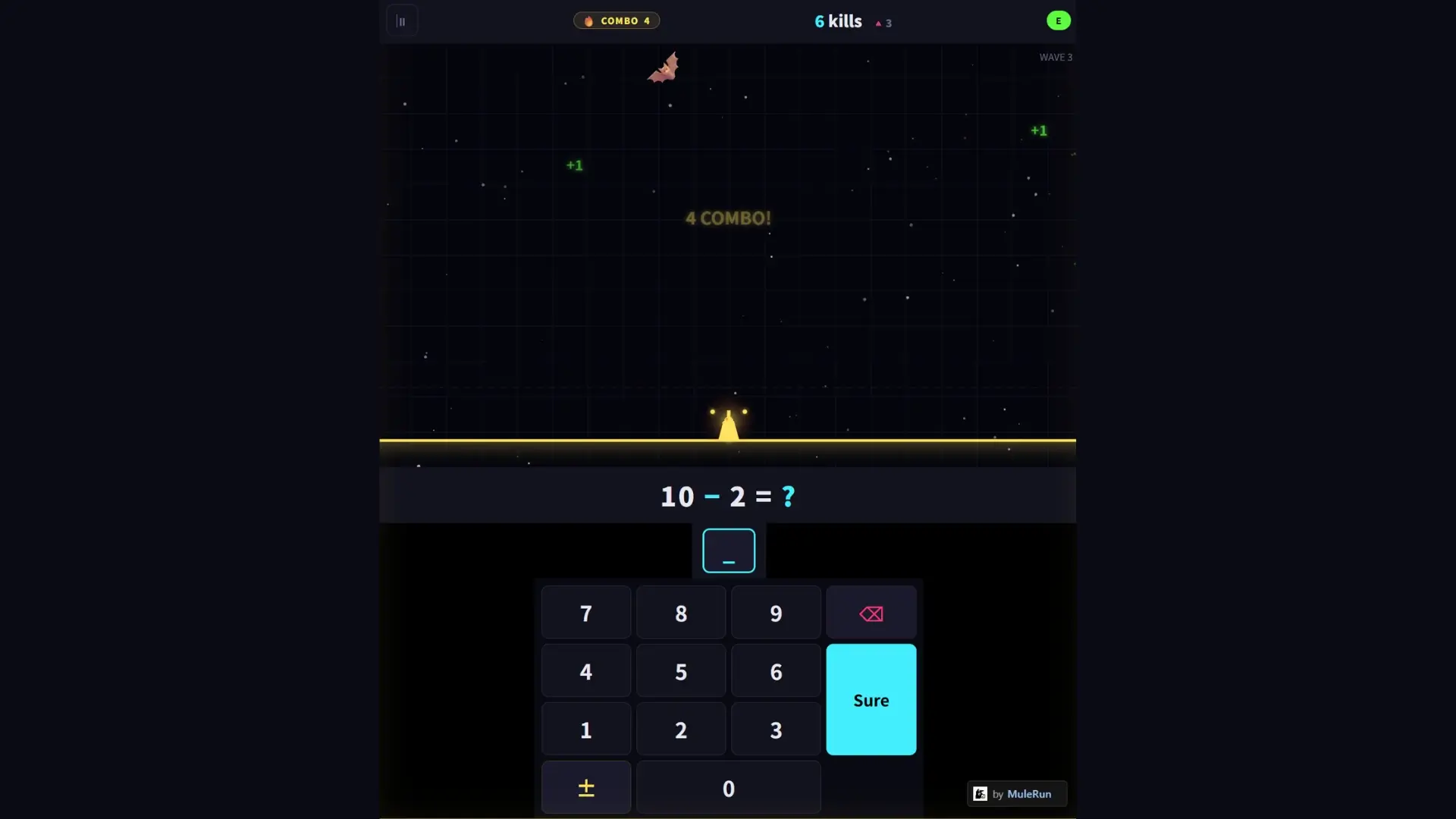
In Math Tower Defense, a wrong answer does not show a red X. It accelerates enemies toward your base: bat-shaped creatures swooping across a dark starfield, getting closer wave by wave. A correct answer fires your turret. Get four in a row and “4 COMBO!” flashes across the screen in gold as your tower lights up and unleashes a barrage.
Students do not push for longer streaks because they want to practice math. They push because they want to keep that combo alive. The repetitions happen as a side effect of chasing a high score.
That is the difference between mathematics as a worksheet and mathematics as a game mechanic.
What is Math Tower Defense
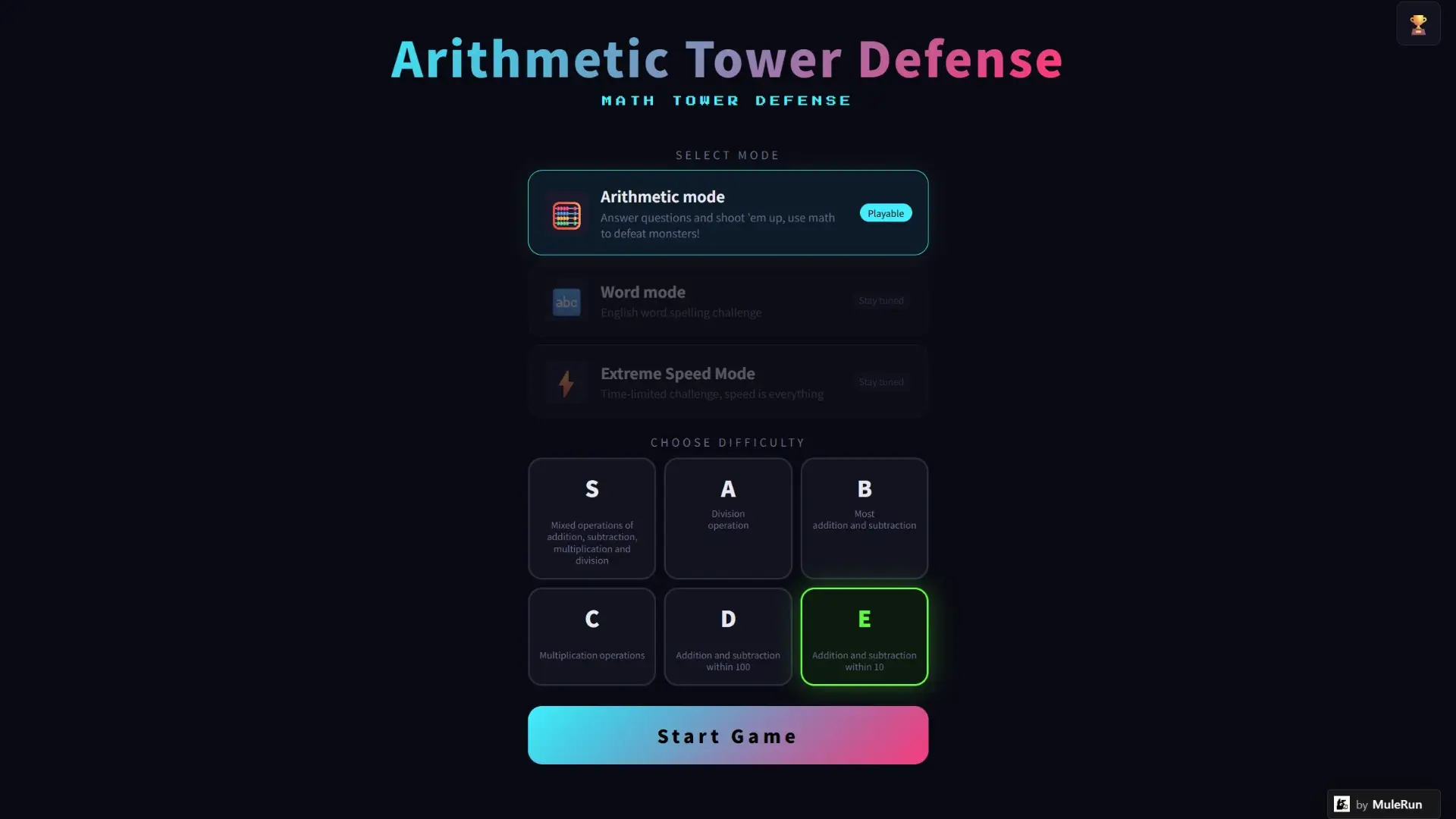
The start screen gives players two choices before anything else: game mode and difficulty level.
On the mode side, Arithmetic mode is live and playable: answer math questions to shoot down enemies. Word mode (English spelling) and Extreme Speed Mode (time-limited challenge) are coming soon, meaning the game already has a roadmap built in.
On the difficulty side, six tiers are available:
- E: Addition and subtraction within 10 (the recommended starting point, highlighted in green)
- D: Addition and subtraction within 100
- C: Multiplication operations
- B: Most addition and subtraction
- A: Division operations
- S: Mixed operations: addition, subtraction, multiplication, and division combined
In gameplay, the screen splits into two halves. The top half is the battlefield: bat enemies fly toward your tower against a dark grid background scattered with stars, with kill count, wave number, and combo status displayed at the top. The bottom half is the answer panel, where the current equation appears in large text and a clean numeric keypad sits below it with a cyan “Sure” confirm button. The plus/minus key handles negative numbers.
Every correct answer fires the turret. Every streak pushes the combo meter higher. The game tracks kills, waves survived, and current difficulty tier in real time.
Teaching Math Basics Through Games
The combo system is the key mechanic. Five escalation levels reward consecutive correct answers with increasingly powerful attacks, from a single bullet up to a five-shot Overdrive barrage. The student is not thinking “I need to answer ten more questions.” They are thinking “I need to get one more right to keep the combo.” The arithmetic becomes the means to a game goal, not the goal itself.
Wave-based enemy spawning reinforces this: spawn intervals decrease and enemy speed increases each wave, so difficulty scales naturally with the player’s momentum rather than a fixed timer.
How to Make a Game With AI, No Coding Required
MuleRun Chat is not just an AI game maker. It is a super agent that handles the entire build for you: code, visuals, logic, and deployment, hands-free. Describe the game in plain language and it does everything else. No coding assistant to prompt line by line, no templates to configure, no deployment pipeline to manage.
Open MuleRun Chat and describe the concept. One sentence is enough to start.
A 3rd grade teacher covering multiplication tables might type:
“Build a space invaders game where students answer multiplication problems (1 to 12 times tables) to shoot down aliens. Include three difficulty levels and a score tracker.”
A parent whose child is struggling with fractions might type:
“Make a racing game where the car speeds up when my kid answers fraction problems correctly. Keep it simple for a 10-year-old.”
MuleRun Chat builds the game, deploys it to a live URL, and gives you a shareable link, ready for a classroom of students to open on their own devices or for one child to play at home.
Why This Beats Ready-Made Math Game Platforms
Platforms like Khan Academy and Cool Math Games are good products, but they are fixed. You cannot change the game format, adjust which topics appear, or control the difficulty curve. You use what they built, the way they built it.
However, MuleRun Chat gives you the design authority. You define the game, choose the math, and control the experience. Personalize your students’ learnings as per their needs and curriculum. The output is a standalone web app at a live URL with no student accounts, no data collection, no subscription, and no ads.
Your students have a math lesson tomorrow, and they could be playing a game you built today.
Sign up free and build your own games now.