
What Are Writing Prompts and How Do They Help Students Improve?
Every student hits a moment where the blank page feels impossible. Writing prompts solve that problem by giving students a concrete starting point, a question, a scenario, or an image, so they can focus on developing ideas instead of staring at an empty screen. The National Center for Education Statistics reports that structured writing practice across grade levels directly correlates with improved composition skills, and prompts are one of the most accessible ways to build that habit.
Opinion writing prompts teach students to form and defend arguments. Fantasy writing prompts push them to build worlds and characters from scratch. Journal writing prompts develop reflective thinking and emotional vocabulary. Picture writing prompts strengthen observation and descriptive language. Narrative essay topics challenge students to structure real or imagined experiences with a clear beginning, middle, and end. Each genre exercises a different cognitive muscle, and rotating through them gives students a well-rounded writing practice.
A language teacher recently used MuleRun Chat to generate a full collection of 55 writing prompts spanning first grade through high school, organized by grade level and genre, complete with word count targets and writing tips for each prompt. The entire collection was built from a single conversational prompt with no curriculum design experience required.
How an AI Agent Generated 55 Writing Prompts in One Conversation
The Prompt That Started It All
The teacher opened MuleRun Chat and typed one sentence: “Generate a comprehensive collection of creative writing prompts for students across different grade levels, organized by theme and difficulty, with tips for teachers on how to use each prompt to inspire student writing.” The AI agent interpreted the request, structured the output into grade bands (1st through 5th grade, middle school, and high school), and organized prompts across five genres: opinion, fantasy, journal, picture prompt, and narrative.
The result was a live, filterable web page, not just a static PDF or a plain text list. Each prompt card displays the grade level, genre tag, prompt text, a suggested word count range, and a specific writing tip tailored to that prompt’s difficulty level. You can try the same prompt yourself and generate your own version of this collection.
Try this template in MuleRun Chat to generate your own writing prompt collection.
Filtering by Grade and Genre
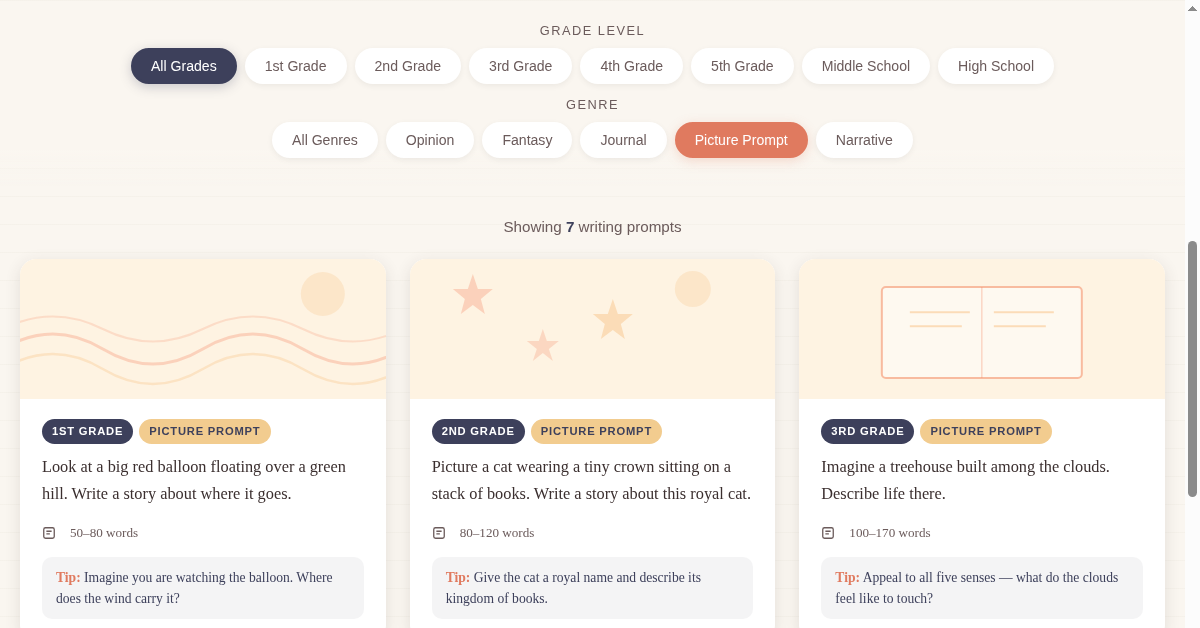
The page includes two filter rows at the top. The grade-level filter lets you narrow results to a specific band from first grade, second grade, all the way through high school. The genre filter isolates one writing style at a time. You can combine both filters to find exactly what you need: third-grade fantasy writing prompts, high school opinion prompts, or middle school journal entries.
This filtering system is what makes the collection practical for teachers. Instead of scrolling through 55 prompts to find one that fits, you select the grade and genre and see only the relevant cards. A first-grade teacher preparing a journal writing lesson and a high school English teacher looking for narrative essay topics can use the same page without overlap.
Opinion, Fantasy, Journal, and Picture Writing Prompts by Grade Level
Story Starters for Kids in First Through Third Grade
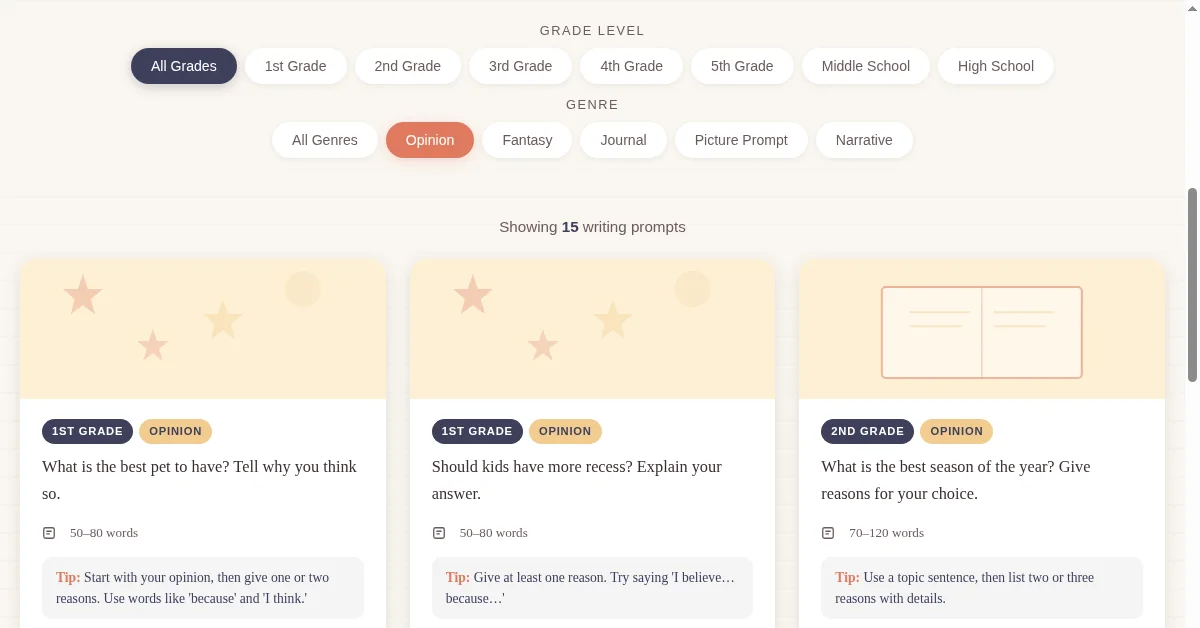
Story starters for kids in the earliest grades use simple, concrete scenarios that connect to everyday experiences. A first grader answering “What is the best pet to have?” practices forming an opinion and giving one reason. A second grader writing about a cat wearing a tiny crown sitting on a stack of books works with picture writing prompts that develop descriptive vocabulary. A third grader imagining a treehouse built among the clouds builds sensory detail into fantasy.
- First grade prompts: 50 to 80 words, focused on one clear idea with simple sentence starters like “I think” and “I believe”
- Second grade prompts: 70 to 130 words, introducing multiple reasons and basic narrative structure
- Third grade prompts: 100 to 200 words, requiring time-order words, opinion-reason-conclusion structure, and five-sense descriptions
Each prompt includes a writing tip calibrated to the grade level. First graders get sentence starters. Second graders get structural guidance like “tell who, what, when, and where.” Third graders get technique-focused advice like “build suspense, don’t reveal the treasure right away.”
Narrative Essay Topics for Fourth and Fifth Graders
Fourth and fifth grade is where writing assignments start resembling what students will encounter in middle school. The prompts in this range ask students to consider opposing viewpoints, develop multi-paragraph arguments, and write narratives with emotional depth.
- “Should homework be given every night?”: a fourth grade opinion prompt that asks students to support a position with at least two reasons and address the counterargument
- “Write about a day you were the hero”: a fourth grade narrative prompt with the tip “show, don’t tell” to introduce a technique they will use through high school
- “Should schools replace textbooks with tablets?”: a fifth grade opinion prompt requiring evidence-based reasoning and a counter-argument
- “Every night at midnight, the paintings in the museum come to life”: a fifth grade fantasy prompt that encourages students to reference real art to make their writing vivid
Word counts increase to 150 to 300 words, and tips shift from structural to technique-oriented. Students at this level are not just answering what they think. They are learning to argue why.
Fantasy Writing Prompts for Middle and High School
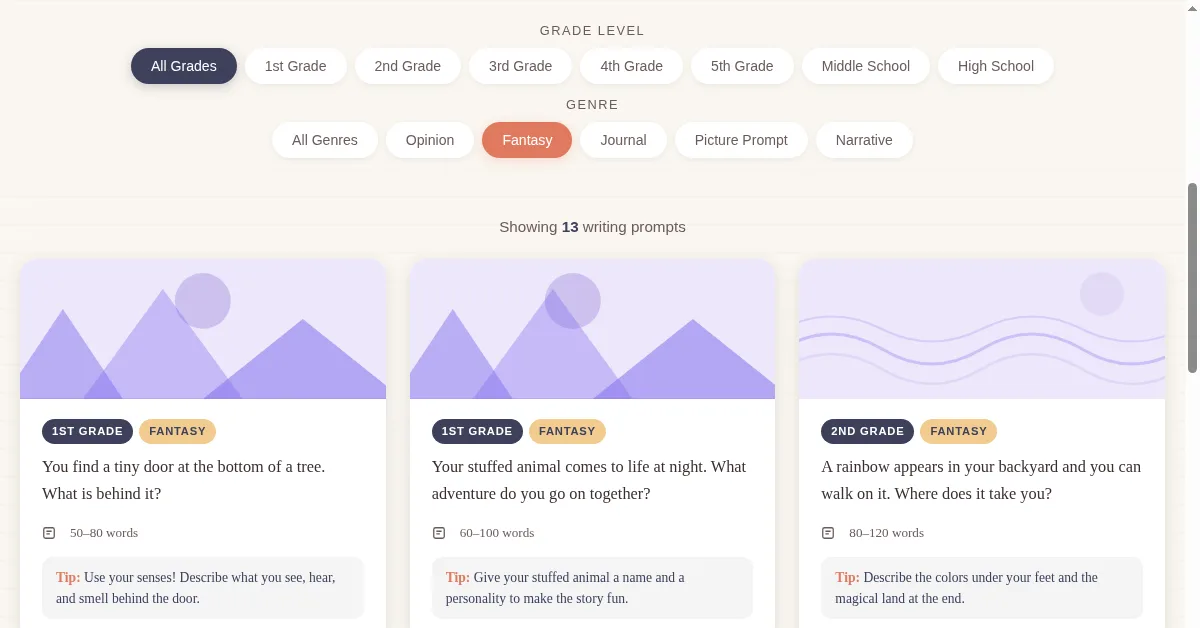
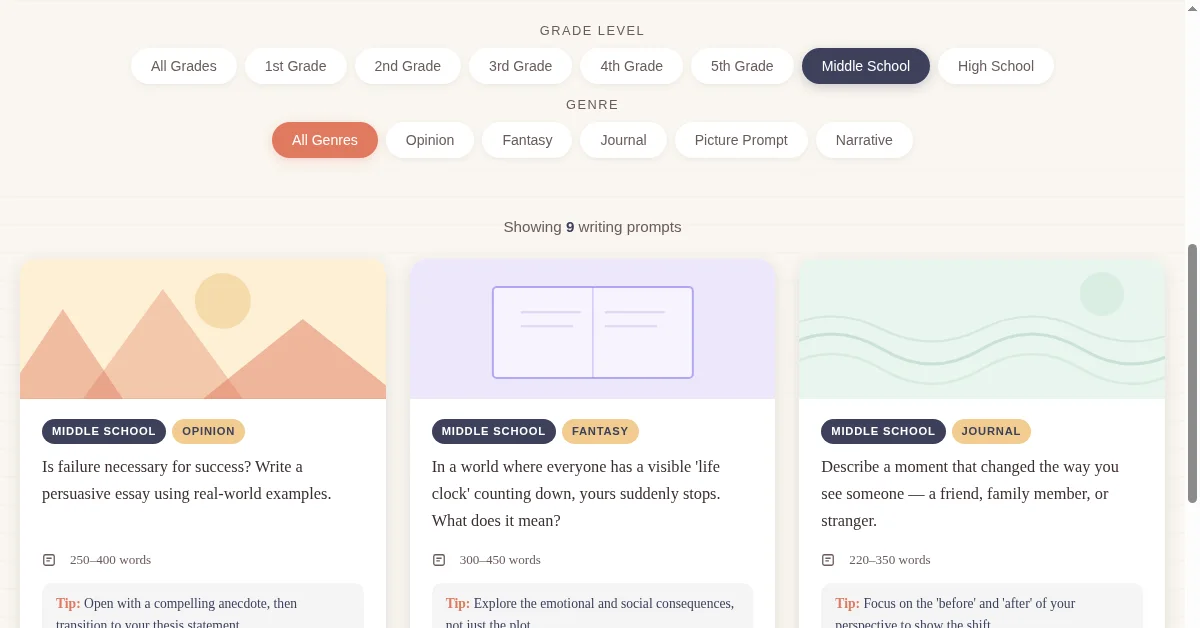
Fantasy writing prompts for middle and high school move beyond simple imagination exercises into world-building, philosophical questions, and emotional complexity. A middle schooler writing about a phone that only receives calls from their future self explores dramatic irony. A high schooler describing a society where memories can be bought and sold engages with themes of identity and commodification.
- Middle school fantasy prompts: 280 to 450 words, emphasizing emotional and social consequences alongside plot
- High school fantasy prompts: 400 to 600 words, requiring world-building through specific detail rather than exposition
- Middle school opinion prompts: structured arguments with at least three points and direct engagement with counterarguments
- High school opinion prompts: nuanced argumentative essays acknowledging complexity, referencing multiple sources
The collection also includes middle and high school journal writing prompts for self-reflection (“Reflect on a belief you once held strongly but have since changed”) and picture writing prompts that function as literary analysis exercises (“An abandoned greenhouse is overtaken by wildflowers, let the greenhouse be a metaphor”). Students wondering what to write about can filter by genre and find a prompt matched to their skill level within seconds. Even students searching for fanfic prompts will find fantasy scenarios here that channel the same creative energy into structured assignments.
How MuleRun Chat Works as an Essay Prompt Generator
The question “what should I write about” is one of the most common searches among students and teachers. MuleRun Chat answers it differently than a search engine. Instead of returning a blog post with a static list of ideas, MuleRun builds a complete, interactive product from your description. You describe what you need in plain language across grade levels, genres, difficulty progression, word counts, and the AI agent writes the code, designs the layout, and publishes the result as a shareable web page.
This makes MuleRun Chat function as an essay prompt generator that produces not just ideas but a usable classroom tool. A teacher preparing for a writing unit can generate a custom prompt collection in one conversation, filter it by the grades they teach, and share the link with students. The prompts are not generic templates pulled from a database, they are generated fresh based on the teacher’s specific description.
The National Council of Teachers of English emphasizes that effective writing instruction requires frequent, varied practice across genres. A prompt collection like this one, spanning opinion, fantasy, journal, picture, and narrative genres across eight grade bands, gives teachers exactly that structure. The NAEP Writing Assessment framework similarly organizes student writing expectations by grade and genre, and MuleRun’s output aligns with that progression naturally because the AI agent structures difficulty based on educational conventions.
For teachers looking for the best AI for writing essays and educational content, MuleRun Chat stands apart because the output is a functional product, not a document. You get a published page with filtering, responsive design, and shareable URLs that are ready for immediate classroom use.
Start Writing with AI-Generated Prompts Today
Have an idea for a writing prompt collection, a classroom tool, or a student resource? Sign up for MuleRun Chat, describe what you need, and watch it come to life.